Join our Zoom event in partnership with Microsoft & receive up to RM10,000 in Caction and Microsoft Power BI usage credits. T&Cs apply.
Reduce overdue issues, missed follow-ups, inconsistent inspections and operational blind spots with real-time visibility across your facilities operations.
From incident reporting and inspections to maintenance, repairs, third-party coordination and issue resolution, every facility generates a growing trail of operational information. Caction connects your facilities, assets, jobs, SOPs, service history and follow-ups in one platform — so your team knows what was reported, what was done, what is still pending and what needs attention next.

 Nurachem
Caction has been a great help to us in tracking our sales data and observing our sales team. We have experienced excellent support on the technical parts of the system and also a very good response time from Caction.
Facilities management companies do not just need another way to create work orders — they need to connect people, facilities, assets, jobs, SOPs and service records into one operational picture. Caction is trusted by facilities management businesses including Nurachem Sdn Bhd.
Issue Resolution
Track reported issues through to resolution
Inspection & SOP Compliance
Ensure inspections and patrols follow standard procedures
Asset & Service History
Access asset information and previous service records
Pending Work Visibility
Stay on top of issues waiting for parts or third parties
Facilities management is not just about keeping buildings running. It is about making sure every reported issue is followed up, every inspection is completed, every SOP is followed and every unresolved problem is visible.
Replace scattered WhatsApp updates, spreadsheets and manual follow-ups with a clearer way to manage facility operations, track issues and maintain accountability across teams
Facilities teams may need to:
Capture every reported issue as soon as it comes in, with the details that matter.
Give every job an owner, a priority and a timeline.
Carry out the on-site work with checklists, photos and sign-offs as proof.
Keep outstanding issues visible until they’re actually resolved.
Confirm required steps were completed before marking an issue closed.
Facilities teams manage a constant stream of complaints, maintenance requests, inspections and site issues. When requests come through WhatsApp, calls, emails or verbal instructions, it becomes difficult to maintain a clear view of what has been reported, what has been assigned and what is still outstanding. The result is a growing list of pending issues, repeated follow-ups and a higher risk of something being overlooked.
Caction brings facility requests, inspections, maintenance jobs and follow-ups into one connected view, so teams can see what needs attention without piecing together updates from different channels.
A facilities management team may receive dozens of complaints and work requests every day. The work itself may be straightforward. The difficult part is making sure nothing gets lost between reporting, assignment, execution, follow-up and resolution. This becomes harder when:
Caction helps facilities teams assign and schedule jobs with clear owners, priorities and timelines, giving everyone a clearer view of upcoming and outstanding work. Coordinate work across teams and sites, reduce scheduling gaps and make sure every job has someone responsible for getting it done.
Routine inspections, cleaning, maintenance and site checks may be carried out by different workers, contractors and teams. Without clear SOPs and structured workflows, the same task can be handled differently from one person or site to another. Managers may only discover that something was missed after a complaint is raised or a problem becomes more serious.
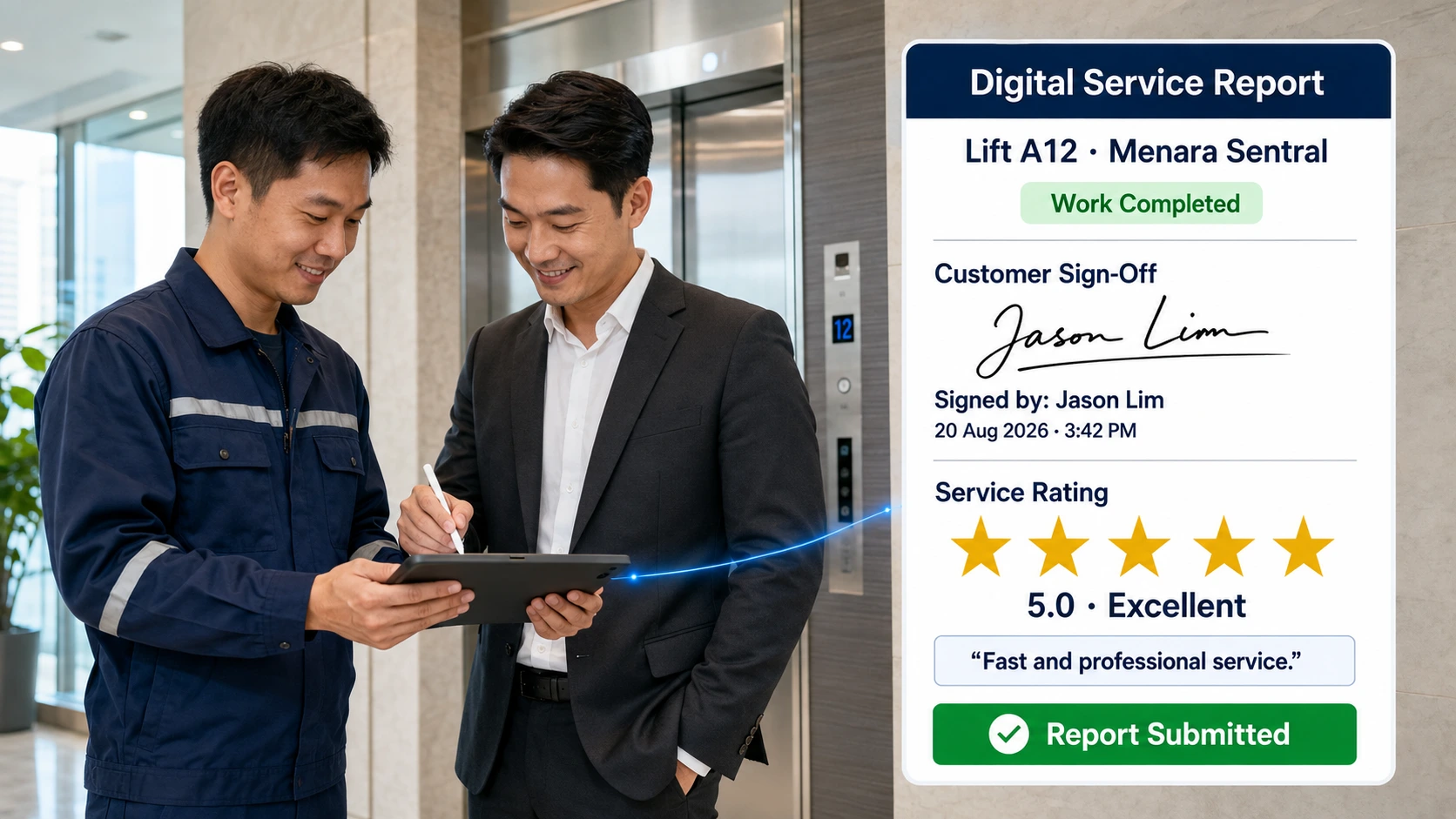
Caction helps facilities teams standardise how work is carried out across different workers, contractors and sites with digital SOPs and structured checklists. Teams follow the required steps and capture photos, videos, timestamps and sign-offs as proof of work, helping managers maintain more consistent service quality regardless of who performs the job.
Facility issues can come from tenants, inspections, patrols or maintenance teams. Without a clear tracking process, requests can remain unresolved, get passed between teams or require repeated follow-ups.
Caction connects reported issues, job assignments, progress updates and follow-up actions, giving facilities teams a clearer view of what has been reported, who is handling it and what is still outstanding. Track issues from report to resolution, reduce missed follow-ups and make sure outstanding problems stay visible until they are resolved.
Facilities operations generate a large amount of information — work orders, inspection findings, contractor updates, asset history and recurring issues. When this information is fragmented, managers are often relying on manual updates rather than a live operational picture. It becomes harder to see which issues are recurring, where work is falling behind and whether teams or contractors are actually keeping sites under control.
Get a clear overview of every job and its current status — what is pending, in progress, completed or needs follow-up. Managers can see who is handling each job, what has been done and what is still outstanding, without chasing teams or contractors for updates.
Facilities teams manage a constant stream of complaints, maintenance requests, inspections and site issues. When requests come through WhatsApp, calls, emails or verbal instructions, it becomes difficult to maintain a clear view of what has been reported, what has been assigned and what is still outstanding. The result is a growing list of pending issues, repeated follow-ups and a higher risk of something being overlooked.
Caction brings facility requests, inspections, maintenance jobs and follow-ups into one connected view, so teams can see what needs attention without piecing together updates from different channels.
A facilities management team may receive dozens of complaints and work requests every day. The work itself may be straightforward. The difficult part is making sure nothing gets lost between reporting, assignment, execution, follow-up and resolution. This becomes harder when:
Caction helps facilities teams assign and schedule jobs with clear owners, priorities and timelines, giving everyone a clearer view of upcoming and outstanding work. Coordinate work across teams and sites, reduce scheduling gaps and make sure every job has someone responsible for getting it done.
Routine inspections, cleaning, maintenance and site checks may be carried out by different workers, contractors and teams. Without clear SOPs and structured workflows, the same task can be handled differently from one person or site to another. Managers may only discover that something was missed after a complaint is raised or a problem becomes more serious.
Caction helps facilities teams standardise how work is carried out across different workers, contractors and sites with digital SOPs and structured checklists. Teams follow the required steps and capture photos, videos, timestamps and sign-offs as proof of work, helping managers maintain more consistent service quality regardless of who performs the job.
Facility issues can come from tenants, inspections, patrols or maintenance teams. Without a clear tracking process, requests can remain unresolved, get passed between teams or require repeated follow-ups.
Caction connects reported issues, job assignments, progress updates and follow-up actions, giving facilities teams a clearer view of what has been reported, who is handling it and what is still outstanding. Track issues from report to resolution, reduce missed follow-ups and make sure outstanding problems stay visible until they are resolved.
Facilities operations generate a large amount of information — work orders, inspection findings, contractor updates, asset history and recurring issues. When this information is fragmented, managers are often relying on manual updates rather than a live operational picture. It becomes harder to see which issues are recurring, where work is falling behind and whether teams or contractors are actually keeping sites under control.
Get a clear overview of every job and its current status — what is pending, in progress, completed or needs follow-up. Managers can see who is handling each job, what has been done and what is still outstanding, without chasing teams or contractors for updates.
Running a facilities management operation means balancing planned inspections and preventive maintenance with daily complaints, breakdowns, repairs and unexpected issues across multiple facilities and assets.
The coordinator has to decide:
The leaders need to know:
At the same time, technicians, supervisors, contractors and support teams need to work from the same facility, asset and service information.
The challenge isn't simply resolving facility issues. It's maintaining a reliable operational record of what was reported, what was done, what is still pending and what needs attention before a small issue becomes a recurring problem or costly breakdown.
Track Every Issue From First Report to Final Resolution
Capture, assign, monitor and close facility issues in one connected workflow. Give managers visibility into what has been reported, who is handling it, what is still pending and what has been resolved.
Facilities management relies heavily on frontline teams carrying out inspections, maintenance and routine site work consistently. But when every reporting requirement and inspection step depends on memory, different workers can approach the same task differently.
Management can build SOPs directly into digital workflows, defining:
Technicians then follow the same structured process on-site while supervisors can see whether the required steps were completed.
Make the expected standard of work part of the workflow, rather than something workers have to remember — creating greater consistency across teams, sites and recurring tasks.
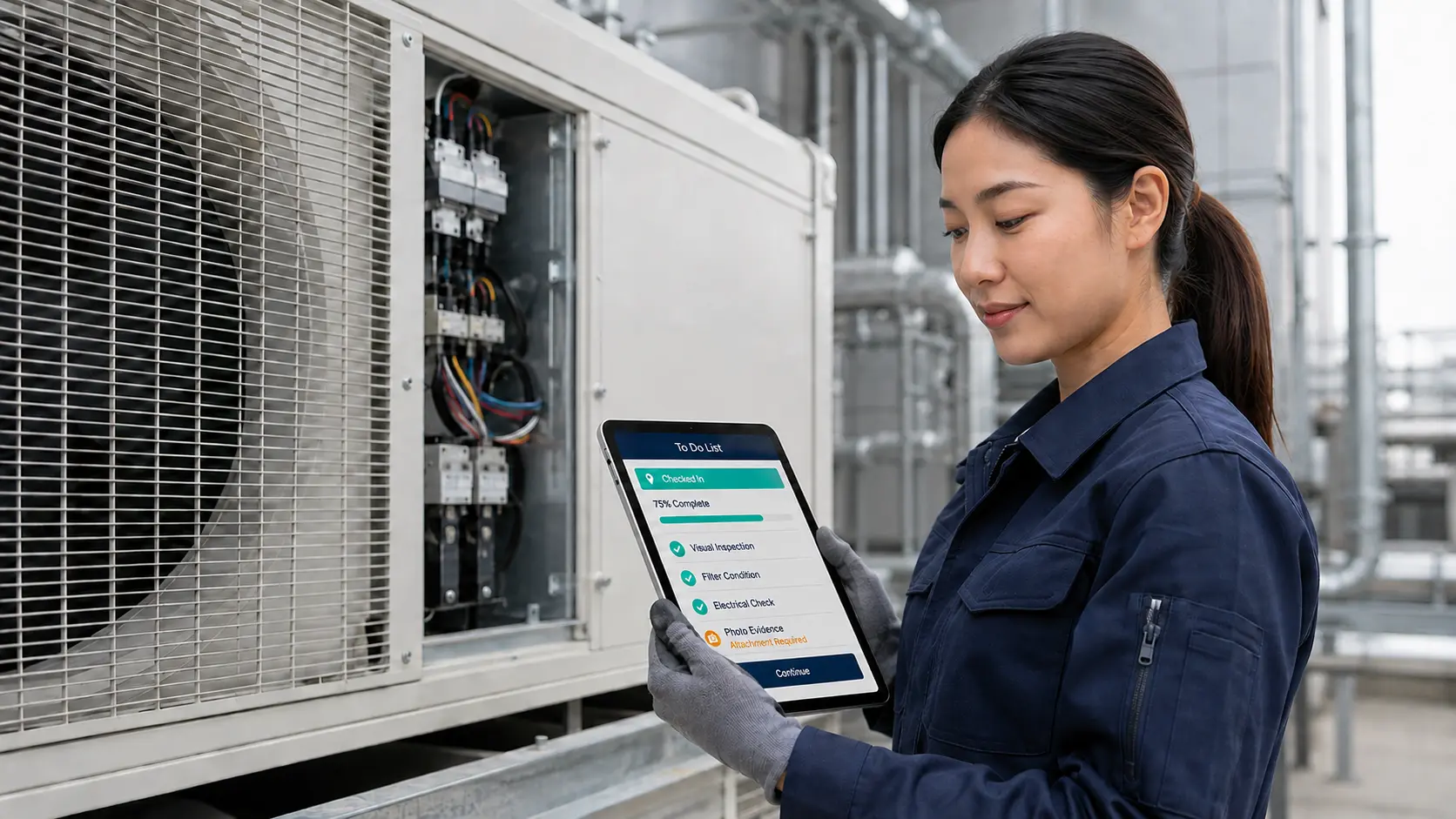
Facilities teams may carry out inspections, patrols and maintenance checks across multiple sites, but managers are often dependent on updates after the work has taken place. A completed checklist alone may not give enough visibility into where the work happened, when it happened and what was found.
Capture field activity as part of the workflow, including:
Give supervisors a clearer view of activity across sites without relying entirely on verbal or manual updates — knowing what was inspected, when it happened, where it happened and what condition was found.
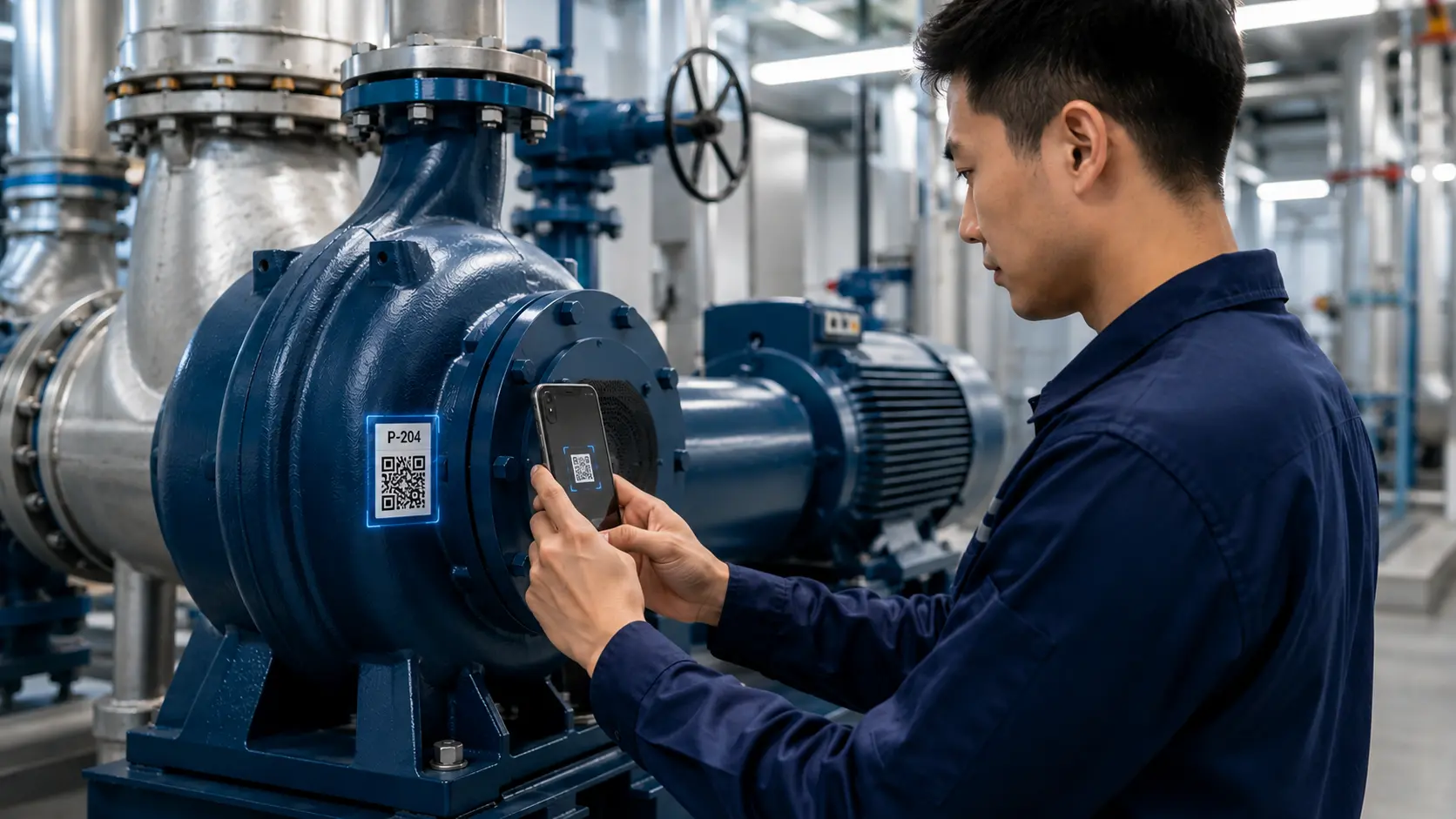
Facilities can contain hundreds or thousands of assets, from air-conditioning units and pumps to generators, fire protection equipment and lifts. When asset history is buried in spreadsheets or paper records, technicians can start each job without knowing what happened previously.
Use QR asset scanning to quickly access the relevant asset record and service history. Technicians can identify the asset, review previous work, report a new issue, start a service job and record repairs from the field.
Give teams the context they need before working on an asset. When the same equipment repeatedly generates faults, its connected history makes those patterns easier to recognise instead of treating every incident as a separate problem.
In facilities management, the job that is waiting can be just as important as the job being worked on. Issues may be waiting for spare parts, quotations, approvals, contractors, specialist expertise or customer confirmation, with updates scattered across different conversations and records.
Give every outstanding issue a clear status, owner and next action. Teams can track:
Keep pending work visible until it is actually resolved. Managers can quickly see what is waiting, who is responsible and what needs to happen next instead of relying on manual follow-ups.
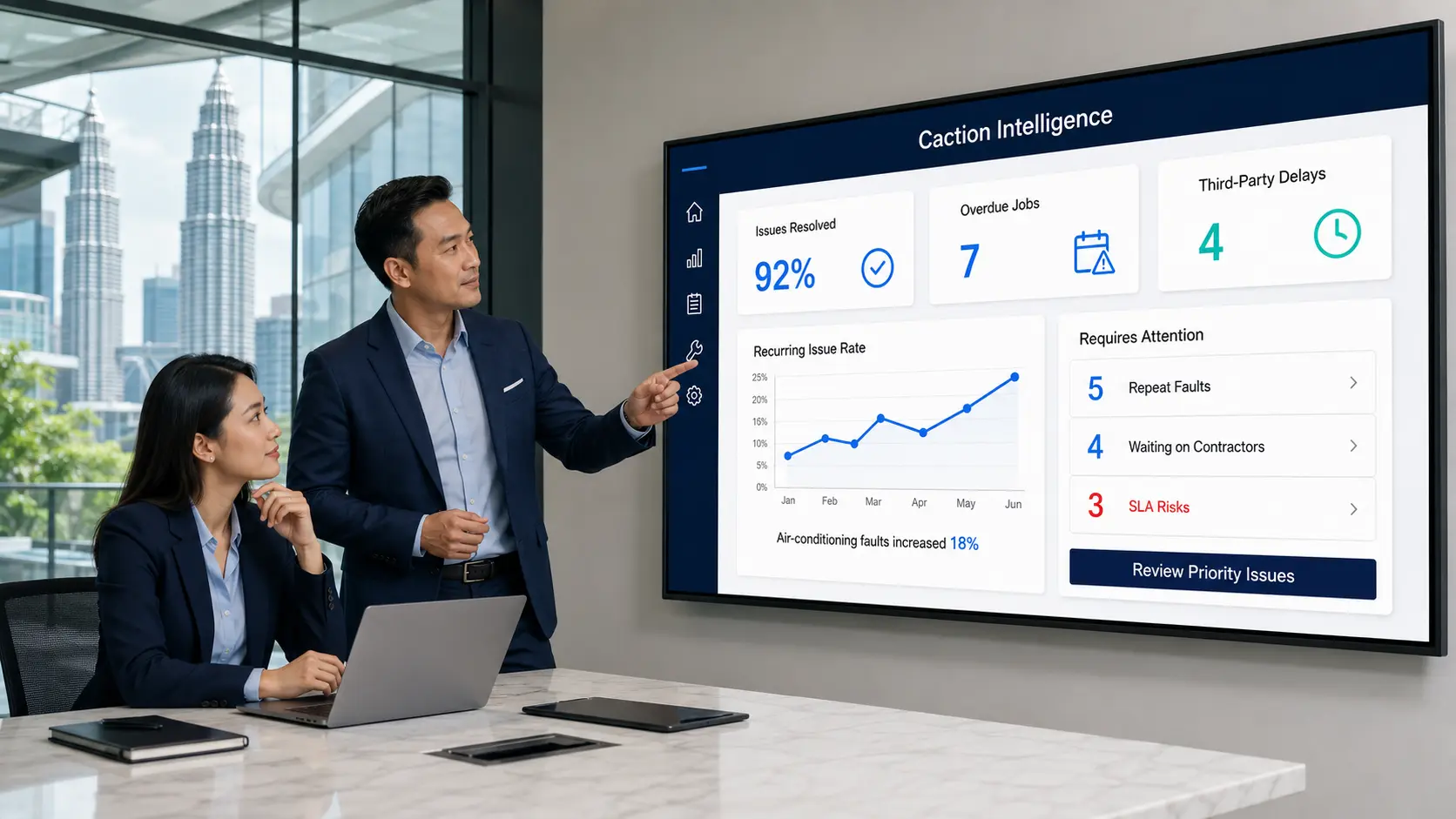
Facilities management generates a constant stream of operational activity — maintenance requests, inspections, breakdowns, contractor jobs, asset issues and follow-ups. The challenge is turning all of that activity into something managers can actually use. Instead of looking at isolated jobs, Caction Intelligence helps reveal where work is building up, what keeps going wrong and where teams are spending the most effort.
Caction Intelligence helps managers move from “What jobs are open?” to “What is causing the operational workload?”
| Operational Signal | What It Reveals | Management Action |
|---|---|---|
| High maintenance volume | Sites or assets generating disproportionate work | Investigate the source of recurring demand |
| Repeated faults | Problems that are being addressed multiple times | Review the underlying issue instead of repeatedly treating the symptom |
| Long resolution times | Jobs or issue types that consistently take longer | Identify bottlenecks and improve resolution processes |
| Growing overdue work | Areas where outstanding tasks are accumulating | Focus resources where the backlog is creating risk |
| High rework | Jobs requiring additional attention after completion | Review service quality and workflow effectiveness |
| Uneven workloads | Teams or individuals carrying significantly different job volumes | Rebalance resources and improve planning |
| Increasing breakdown activity | Assets or sites becoming more problematic | Review maintenance strategy and asset condition |
The goal is not simply to collect more maintenance data. It is to understand what that data is telling you — so managers can address recurring problems, remove operational bottlenecks and keep facilities running more effectively.
Keep Every Site Maintained, Every Issue Visible and Every Task Accounted For
Facilities management is not just about responding when something breaks. Every site has a constant flow of complaints, inspections, preventive maintenance, breakdowns, contractor work and follow-ups. When these activities are managed through spreadsheets, calls, WhatsApp and separate records, issues can be missed, work can be delayed and recurring problems can continue unnoticed.
Caction gives facilities teams a connected operational view so they can stay on top of daily work, maintain service standards and keep issues moving towards resolution.
| Before Caction | With Caction |
|---|---|
| Issues are reported through calls, WhatsApp and emails | Capture and manage facility issues through a structured workflow |
| Managers rely on workers to provide updates | See job status and progress without constantly chasing updates |
| Inspections are recorded inconsistently | Use digital inspection workflows and standardised checklists |
| SOPs depend on workers remembering the process | Build required procedures directly into workflows |
| Maintenance history is scattered across different records | Connect service activity to the relevant asset and site |
| Managers struggle to know what is still pending | See open, overdue, waiting and completed work in one place |
| Technicians may arrive without knowing previous issues | Access relevant asset and service history before starting work |
| Recurring problems are treated as individual incidents | Identify repeated issues across assets and sites |
| Site managers receive updates after work is completed | Capture job information and field updates as work happens |
| Managers rely on manual reports to understand performance | Use operational data to identify workload, delays and recurring issues |
| Teams spend time searching across different channels | Bring facility, asset and service activity into one operational view |
Stay Ahead of Facility Issues
Know what has been reported, what has been assigned, what is being worked on and what is still waiting. Give managers a clear view of outstanding work before small issues become bigger operational problems.
Standardise Work Across Every Site
Different sites and workers should not mean different standards. Build SOPs, checklists and required steps into workflows so teams know what needs to be done, what needs to be recorded and when an issue needs to be escalated.
Know What Is Happening Across Your Sites
Facilities teams may be responsible for multiple buildings with hundreds of maintenance activities taking place at any one time. Bring site, asset, job and maintenance information together so managers can see where work is happening and where attention is needed.
Give Technicians the History They Need
When an asset breaks down repeatedly, technicians should not have to start from scratch. Use QR asset scanning to access relevant information and previous service activity, helping technicians understand what happened before and what has already been done.
Keep Inspections Accountable
Routine patrols and inspections are only useful when teams consistently carry them out. Digital checklists, timestamps, geofenced check-ins, photos and service reports give supervisors greater visibility into what was inspected, when it happened and what was found.
Stop Pending Work From Getting Lost
Facilities work often gets delayed while waiting for parts, quotations, approvals, contractors or specialist support. Keep these jobs visible with clear statuses, ownership and follow-up actions so pending work does not disappear into conversations or spreadsheets.